Reieop Akademi
dog5564 · 2026-08-09 · Source naver
Reieop Akademi is a trainer education institution located at 269 Hyowon-ro, 3F, Suite 305, Paldal-gu, Suwon-si, Gyeonggi-do, offering practice-oriented training courses that follow an assessment-interpretation-intervention-reassessment flow.
See the full business overview →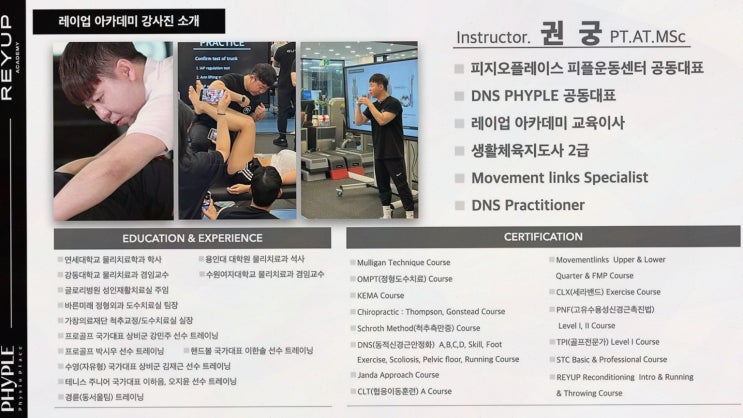
| Source | dog5564 · blog.naver.com/dog5564 |
|---|---|
| Published | 2026-08-09 |
| Original | View original → |
Key information
| Address | Gyeonggi-do Suwon-si Paldal-gu Hyowon-ro 269 3F Unit 305 |
|---|---|
| Curriculum | Ankle & Foot, Hip, Squat, Running, Throwing courses, etc. |
| Educational features | Focuses on the thought flow of assessment-interpretation-intervention-reassessment |
| Instructor team | International instructors |
What sets it apart
직영점 확장과 수원 스타필드 입점으로 브랜드형 리컨디셔닝 센터 이미지를 갖춤 — 스타필드점·광명직영점 확장 후기
Note: 단순 헬스장·스피닝·사우나 등 일반 피트니스 부대시설 니즈에는 덜 맞을 수 있음
Frequently asked questions
Q. What does the Reieop Akademi trainer education cover?
Reieop Akademi trainer education focuses on the thought flow of movement assessment, cause interpretation, intervention, and reassessment, and enhances practical application skills through courses such as Ankle & Foot, Hip, Squat, Running, and Throwing.
Q. Where is Reieop Akademi located?
Reieop Akademi is located at 269 Hyowon-ro, 3F, Suite 305, Paldal-gu, Suwon-si, Gyeonggi-do.
Q. What are the educational features of Reieop Akademi?
Reieop Akademi education is not just theoretical delivery; it emphasizes teaching the thought flow of assessment-interpretation-intervention-reassessment through actual practice, so that trainees can immediately apply assessment methods in the field.
Q. What is the composition of the instructor team?
Reieop Akademi consists of international instructors, so trainees can gain a broad perspective through example-centered classes and natural discussions.
Q. What changes can be expected after completing Reieop Akademi education?
After completing Reieop Akademi education, trainees will develop an assessment habit, enabling them to analyze the cause of movement and apply a reassessment routine in the field, rather than only looking at the painful area.