Eichieneoji Sollasweeo 2 . 0
clare226 · 2026-08-24 · Source naver
Eichieneoji Sollasweeo 2.0 is a factory solar panel rental product that leases the roofs of factories, logistics warehouses, and industrial complex buildings to install solar power generation with zero initial cost, and generates rental income. It is a 20-year long-term business that includes operation and management.
See the full business overview →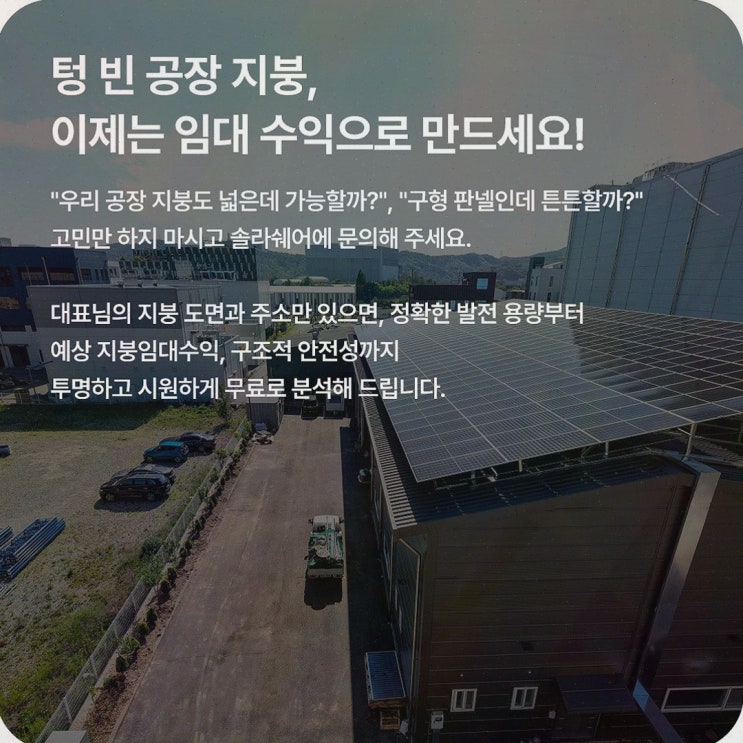
| Source | clare226 · blog.naver.com/clare226 |
|---|---|
| Published | 2026-08-24 |
| Original | View original → |
Key information
| Initial cost | 0 KRW (roof lease method) |
|---|---|
| Rent example (5-year prepaid type) | 300 pyeong (150kW): 60 million KRW in year 1, total revenue 150 million KRW |
| Rent example (500 pyeong) | 500 pyeong (250kW): 100 million KRW in year 1, total revenue 250 million KRW |
| Rent example (1000 pyeong) | 1000 pyeong (500kW): 200 million KRW in year 1, total revenue 500 million KRW |
| Rent example (2000 pyeong) | 2000 pyeong (1,000kW): 400 million KRW in year 1, total revenue 1 billion KRW |
| Operation management | SolOnCare monitors over 5,000 power plants nationwide 24 hours a day with AI real-time management. |
Frequently asked questions
Q. What is the initial cost for factory solar panel rental?
Eichieneoji Sollasweeo 2.0 installs solar panels through roof leasing with zero initial cost.
Q. How much annual rental income does Sollasweeo 2.0 provide?
For the 5-year advance payment type of Eichieneoji Sollasweeo 2.0, rent examples are: 60 million KRW in year 1 for 300 pyeong (150kW), 100 million KRW for 500 pyeong (250kW), 200 million KRW for 1,000 pyeong (500kW), and 400 million KRW for 2,000 pyeong (1,000kW).
Q. How is maintenance handled for factory solar panel rental?
After installation, Eichieneoji Sollasweeo 2.0 provides 24-hour central monitoring and AI real-time management for over 5,000 power plants nationwide through SolOnCare.
Q. Is factory solar panel rental possible even if the roof condition is poor?
Eichieneoji Sollasweeo 2.0, for buildings with roof leaks, insulation issues, or waterproofing concerns, first conducts a condition review and discusses utilization proposals.