Sollasweeo 2 . 0
2899923 · 2026-08-04 · Source naver
Sollasweeo 2.0 is an industrial complex solar panel rental service that leases factory rooftops with zero initial cost, providing rental income and electricity bill savings through rooftop leasing.
See the full business overview →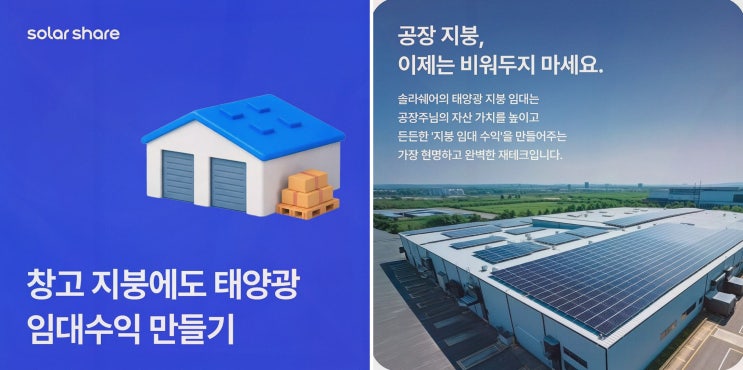
| Source | 2899923 · blog.naver.com/2899923 |
|---|---|
| Published | 2026-08-04 |
| Original | View original → |
Key information
| Initial costs | 0 KRW |
|---|---|
| Example of 5-year prepaid rent (300 pyeong, 150kW) | Year 1: 60 million KRW, Total Revenue: 150 million KRW |
| Example of 5-year prepaid rent (500 pyeong) | Year 1: 100 million KRW, Total Revenue: 250 million KRW |
| Example of 5-year prepaid rent (1,000 pyeong) | Total Revenue: 500 million KRW |
| Example of 5-year prepaid rent (2,000 pyeong) | Total Revenue: 1 billion KRW |
| Solar business period | 20-year long-term project |
Frequently asked questions
Q. What are the conditions for Sollasweeo 2.0's industrial complex solar panel rental?
Sollasweeo 2.0 leases factory rooftops with zero initial cost. The installation capacity and revenue may vary depending on rooftop condition and shading. For example, a 300-pyeong rooftop offers 60 million KRW in year 1 and 150 million KRW in total revenue over 5 years.
Q. What are the revenue examples for Sollasweeo 2.0's solar panel rental?
According to Sollasweeo 2.0's guidance, a 300-pyeong 150kW system yields 60 million KRW in year 1 and 150 million KRW total; 500 pyeong yields 100 million KRW in year 1 and 250 million KRW total; 1,000 pyeong yields 500 million KRW total; and 2,000 pyeong yields 1 billion KRW total.
Q. How is Sollasweeo 2.0's solar power generation managed?
Sollasweeo 2.0 has an operation and management system through SolaOnCare's AI real-time monitoring, checking for abnormalities 24 hours a day from a central location.
Q. What types of companies is Sollasweeo 2.0 suitable for?
Sollasweeo 2.0's industrial complex solar panel rental is suitable for representatives of manufacturing, logistics warehouses, and companies in industrial complexes, allowing them to turn rooftops into a revenue structure.